Symbolism, Imagery & Wordplay
Night and Darkness Imagery
The poem takes place around the time of sunset in a country
churchyard—also known as a cemetery. Kinda spooky, right? And the
darkness of the setting is appropriate for the subject matter, too. The
speaker is talking about the unknown. He's contemplating mortality and
what happens to people after they die. Of course, no one really knows what will happen after death, so the darkness might symbolize the mystery of what happens after we die.
- Line 1: The speaker uses personification in the very first line when he says that the church bell "tolls the knell" of the day. When a person dies, you ring a church bell to commemorate their death, and that's called a "death knell," so the poet is implying that the bell that rings at sundown is commemorating the death of the day, as though the day were a real person.
- Lines 5-6: The speaker uses alliteration, or the repetition of consonant sounds, when he describes the "solemn stillness" of the scene at sunset. The repeated S sound (also known as sibilance) is like a sort of "shushing"—maybe the speaker wants to emphasize the quiet, calm, stillness of the atmosphere.
- Lines 13-16: The speaker uses a metaphor when he says that the dead villagers are only "sleeping" in the shade of the tree. In fact, this is a euphemism, or a polite way of describing something to soften its harsh reality (like saying that you're "excusing yourself for a moment" at a fancy dinner, rather than saying "I have to go pee now"). Why would Gray use a euphemism here? Could be that part of him is afraid of death and his own mortality, so he'd rather think of these villagers as merely "sleeping" or resting comfortably, rather than rotting away underground?
- Lines
53-54: The speaker uses a metaphor when he describes people whose good
qualities go unrecognized as "gems" that are hidden in dark caves under
the ocean.
Farms and the Countryside Imagery
- This poem takes place out in the country. In fact, the setting is so important to the poet that he announces it in the title, just to be sure that you don't miss it! Why would the country make more sense for the setting of this poem? Well, country folks are generally seen as simpler than their city counterparts. Since they're farmers, they're more in tune with the earth and with nature, and more in touch with the things that really matter, according to the speaker—things like the cycles of life and death.
- Line 2: If the title of the poem didn't tip you off right away that we're hanging out in the country, and not in the city, maybe the mooing herd of cows that appears in line 2 will convince you. Guys: this is NOT a city poem. Cows!
- Line 3: The speaker uses alliteration when he repeats the Pl- sound of "plowman plods" and the W sound of "weary way." The repetition of those consonant sounds might help to emphasize how tired the farmer is—he's "plodding" along. It also might emphasize that the farmers do this every single day. Plod, plod, plod.
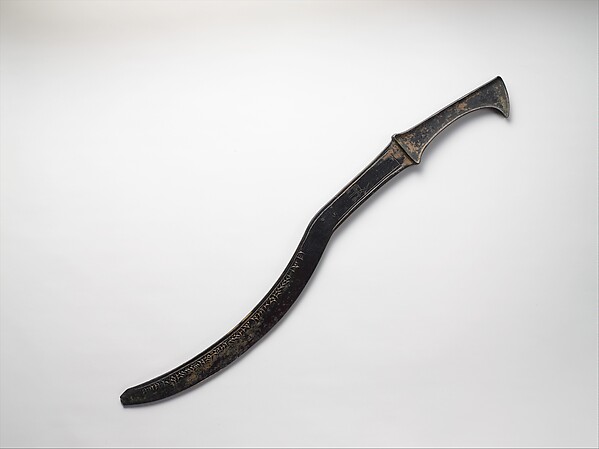
- Line 25: The speaker personifies the harvest when he says that it "yields" to the farmer's sickle, the way a beaten warrior would "yield" or surrender to a superior force. (A sickle is a sharp, curved farm tool used to cut grain. They've been used for so many centuries and millennia that they often get associated with our ancient, primitive ancestors. Here's what a sickle looks like.)
- Line 29: The speaker personifies "Ambition" when he says that we shouldn't let the desire to get ahead and get rich keep us from appreciating the useful work of the farmers.
- Lines 101-104: The poet uses
alliteration to describe the laziness of stretching out under a tree
near a stream. The repetition of the L sounds ("listless length") and of
the B sounds ("brook that babbles by") sort of imitates the sound of
the wind in the tree overhead and the sound of the flowing stream.
Trees and Birds
- There are so many different species of tree and bird named in this poem that it's difficult to list them all. What are all these trees and birds doing in the poem? They're more than just pretty landscape, that's for sure.
For one thing, they could add to the important natural setting of the poem—like the farms and countryside, the trees and birds remind us of cycles of life: trees lose their leaves in the fall and they grow back in the spring. Birds lay eggs and have chicks in the spring. And in a poem about death and mortality, remembering that leaves do grow back and new baby birds are born every year is important. Not only might they represent the cycle of life, but specific types of trees and birds have different traditional symbolic meanings in Western poetry. Let's look at a few examples…
- Line 10: Here's our first bird! It's an owl. The speaker personifies the owl when he says that it's "moping" and "complaining" to the moon. Since owls are nocturnal, they're often associated with death and with spooky hauntings. How appropriate for a poem about death that is set in a graveyard!
- Line 13: Here are our first trees: elms and yews. Elms tend to be associated with strength in poetry (which may be why the speaker calls them "rugged"), while yew trees often represent eternity and immortality. It's not clear whether or not Gray intends to bring up the traditional poetic symbolism of these trees, but "eternity" sure would be appropriate, given that his poem is about death and what happens afterwards!
- Lines 18-19: More birds! First he imagines a twittering, tweeting swallow, which is often associated with farms and barns, since that's where they like to build nests. Swallows are also early risers, like the "cock" or rooster that the speaker imagines crowing in the following line. These are the birds you hear first thing in the morning. The speaker is imagining the deaths of the local villagers, so these are the birds that he says they'll never wake up to hear again.
- Line 101: Another tree—this time, the speaker is imagining how he'll be remembered after he dies. He thinks that folks might recall how he used to stretch out lazily under a beech tree. The beech is traditionally associated with ancient history, the written word, and knowledge of the past. Sounds like a great tree to associate with a poet, don't you think? What kind of tree or bird would you associate with yourself? Why

No comments:
Post a Comment