Friday, 3 January 2014

What’s Up With the Title?


The title of this poem seems pretty straightforward: it announces the genre of the poem and the place where it was written. But let's think a little more about that—an elegy is a mournful, sad poem, especially one that was written to mourn for the dead. And it was, in fact, written (or at least takes place) in a country churchyard. But if this is an elegy, whom is it mourning?
At the start of the poem, the speaker is mourning for the deaths of all the simple country folks who are buried in the churchyard. And by the end of the poem, he is imagining his own death. Some critics think that the poem was inspired by the death of Gray's best friend, Richard West, although West is never mentioned in this poem. So…what do you think? Is the speaker mourning death, in general? Is he mourning for his friend? Or is he really just mourning for his own mortality?

Lines 93-100

For thee, who mindful of th' unhonour'd Dead
Dost in these lines their artless tale relate;
If chance, by lonely contemplation led,
Some kindred spirit shall inquire thy fate,

Haply some hoary-headed swain may say,
"Oft have we seen him at the peep of dawn
Brushing with hasty steps the dews away
To meet the sun upon the upland lawn.

  • Look, gang, more enjambment! The same sentence continues across a stanza break, so we'll look at both stanzas at once.
  • The speaker refers to himself in these lines—he's calling himself "thee."
  • (Fun grammar fact: most modern readers think of "thee" and "thou" as an old-fashioned, fancy-pants version of "you." But no! It's not fancy-pants at all!
  • "Thee" and "thou" were actually informal or more intimate versions of "you." Like French, Spanish, and many other languages that have two versions of "you," English used to have a formal and an informal way of saying "you." And it makes sense that if the poet is addressing himself, he'd use the more informal way of doing so.)
  • Okay, so what's our speaker actually saying to himself? He's saying that he is aware ("mindful") of the dead people who haven't been honored with lots of monuments, so he's memorializing them in these very lines of poetry.
  • Then the speaker wonders what would happen if some random kindred spirit, who happened to be musing on similar things (i.e., death), might ask about the speaker's fate.
  • He answers this question in the next stanza, and with some alliteration thrown in while he's at it ("Haply some hoary-headed" and "swain […] say")!
  • Probably some gray-haired ("hoary-headed") farmer guy ("swain") would say that they had often seen the speaker hurrying through the dew-covered grass to watch the sun come up on the meadow lawn.

    Lines 101-104

  • "There at the foot of yonder nodding beech
    That wreathes its old fantastic roots so high,
    His listless length at noontide would he stretch,
    And pore upon the brook that babbles by.

    • The speaker continues to imagine what the "hoary-headed swain" would say about him, if a random passerby happened to ask.
    • He imagines the old guy saying that at noon, the speaker used to stretch out at the foot of the old beech tree—the one that has fantastically weird roots—and that he would stare at the babbling brook.
    • "Listless length" in line 103 is another great example of alliteration.

      Lines 105-108

    • Hard by yon wood, now smiling as in scorn,
      Mutt'ring his wayward fancies he would rove,
      Now drooping, woeful wan, like one forlorn,
      Or craz'd with care, or cross'd in hopeless love.

      • This stanza continues with what the speaker imagines an old villager would say about him after he was dead and gone.
      • He imagines the old guy saying that the speaker used to rove, or wander, in the nearby woods. 
      • Sometimes, the speaker would smile almost scornfully, while muttering to himself, and sometimes he would look all droopy and mopey, pale ("wan") with sorrow, like he was anxious or else hopelessly in love with someone who didn't love him back. Good times!

        Lines 109-112

      • "One morn I miss'd him on the custom'd hill,
        Along the heath and near his fav'rite tree;
        Another came; nor yet beside the rill,
        Nor up the lawn, nor at the wood was he;

        • The speaker continues to imagine what the old villager might say about him after he's dead and gone:
        • He imagines the villager saying that he missed seeing the speaker one morning in the usual place on a local hillside, along the fields ("heath") by the speaker's favorite tree. (This is probably the beech tree mentioned in Stanza 26.)
        • The villager goes on to say that another day passed, and yet he still didn't see the speaker by the brook ("rill") or on the grass, or by the woods. Sounds like something's up…

          Lines 113-116

        • "The next with dirges due in sad array
          Slow thro' the church-way path we saw him borne.
          Approach and read (for thou canst read) the lay,
          Grav'd on the stone beneath yon aged thorn."

          • The speaker continues to imagine what an old villager would say about him after his death: 
          • And on the third day after the speaker didn't show up, the old villager says that dirges (funeral songs) were played, and that they saw the speaker carried slowly along the path to the church in a funeral procession.
          • The villager invites the random passerby who asked (the "kindred spirit" of line 96) to read the epitaph that is engraved on the speaker's tombstone, underneath the gnarly old thornbush.

            Lines 117-120

          • THE EPITAPH

            Here rests his head upon the lap of Earth
            A youth to Fortune and to Fame unknown.
            Fair Science frown'd not on his humble birth,
            And Melancholy mark'd him for her own.

            • Now we're supposed to imagine that we, like the "kindred spirit" who asked about the dead speaker, are reading Thomas Gray's imagined epitaph. Morbid?
            • Yes. But kind of cool, we have to admit. Let's see what it says…
            • This is where the speaker is resting his head on the ground.
            • Yes, that's a metaphor! Dead people don't really "rest their heads" anywhere—they're dead, after all. And "Earth" is being personified when the speaker imagines that it could have a "lap."
            • The speaker calls himself a young person who is unknown both to Fortune (i.e., good luck or wealth—it could mean either) and to Fame. In other words, he was of humble birth.
            • But at least he was no stranger to knowledge, or science, in spite of his humble origins. He was a scholar and a poet!
            • But, alas, he was sometimes kinda depressed.
            • We get more personification here, too—you can tell because all those nouns (Fame, Fortune, Science, Melancholy) are capitalized.

              Lines 121-124

               
            • Large was his bounty, and his soul sincere,
              Heav'n did a recompense as largely send:
              He gave to Mis'ry all he had, a tear,
              He gain'd from Heav'n ('twas all he wish'd) a friend.

              • He might have had humble beginnings, but he did pretty well for himself—he was generous and sincere, and Heaven paid him back (sent a "recompense") for those good qualities.
              • The speaker gave everything he had to his depression, or (as personified here) Misery—in other words, his tears.
              • But Heaven gave him something pretty awesome: a friend.

                Lines 125-128

              • No farther seek his merits to disclose,
                Or draw his frailties from their dread abode,
                (There they alike in trembling hope repose)
                The bosom of his Father and his God.
                • Don't try to find out anything more about the dead speaker's good points.
                • And don't try to dig up any dirt on his bad points, or frailties, either.
                • Why not, you ask? Both his good and his bad points are in "repose," or resting, hoping for eternal life, in heaven with God. That's why not.

elegy utpto 84 stanzas

Lines 1-4

The curfew tolls the knell of parting day,
The lowing herd wind slowly o'er the lea,
The plowman homeward plods his weary way,
And leaves the world to darkness and to me.

  • So, right off the bat we have some vocab to sort out in this poem. The "curfew" is a bell that rings at the end of the day, but a "knell" is a bell that rings when someone dies. So it's like the "parting day" is actually dying. Sounds like a metaphor!
  • The mooing herd of cows makes its winding way over the meadow ("lea" = "meadows")
  • And the tired farmer clomps on home.
  • Now that the cows and the farmer are out of the picture, the speaker gets everything in the world to himself (he has to share it with the growing darkness, but that's not so bad).
  • Notice that the speaker refers to himself in the first person right away in that first stanza: the parting farmer and cows leave "the world […] to me."
  • This would be a good time to note that the poet often removes vowels and replaces them with an apostrophe, like "o'er" instead of "over" in the second line.
  • If you ever notice an odd-looking word with an apostrophe in it, try replacing the apostrophe with a letter to make a familiar word. Gray makes these contractions to make the number of syllables fit the iambic pentameter. While we're talking about form, we'll also point out the rhyme scheme here—it's ABAB.

Lines 5-8

  • Now fades the glimm'ring landscape on the sight,
    And all the air a solemn stillness holds,
    Save where the beetle wheels his droning flight,
    And drowsy tinklings lull the distant folds;
    • So what's happening, exactly? The "glimm'ring landscape" is fading from the poet's sight. Must be sunset, but we knew that from the first stanza.
    • The air is quiet, too, except for the buzz of the occasional beetle and the tinkling bells hanging around the necks of livestock in their "folds" (a.k.a. barns).
    • Sounds peaceful and sleepy, like everything is winding down.
    • There are some interesting literary devices in these lines, too: "solemn stillness" is a great example of alliteration, and the speaker personifies the "tinkling" of the bells when he says that they're "drowsy." Go to the "Symbols" section for more on these literary tools!

Lines 9-12

  • Save that from yonder ivy-mantled tow'r
    The moping owl does to the moon complain
    Of such, as wand'ring near her secret bow'r,
    Molest her ancient solitary reign.

    • Here are some more exceptions to the overall peace and quiet: the bent-out-of-shape owl is hooting. 
    • More figurative language here! The speaker uses metaphor to describe the tower where the owl lives as "ivy-mantled." (A "mantle" is a kind of cloak or coat, so the speaker is saying that the tower is dressed up in ivy. Cool!)
    • Because the title of the poem says that it was "written in a country churchyard," we can guess that the "tower" mentioned here is probably the church tower.
    • But the speaker doesn't just say that there's an owl hooting—he uses some more figurative language. He personifies the owl when he says that it's "moping" and "complaining," since those are things a person would do, not an owl.
    • And what's the mopey owl complaining about? Apparently, he's complaining that there's an outsider nearby—someone who is wandering near her private digs (a "bower" is a lady's private room) and bothering her solitude.
    • Who is that outsider? Sounds like the owl is probably complaining about the presence of the speaker himself! (And we're just assuming the speaker is a "he.")

Lines 13-16

Beneath those rugged elms, that yew-tree's shade,
Where heaves the turf in many a mould'ring heap,
Each in his narrow cell for ever laid,
The rude forefathers of the hamlet sleep.

  • This stanza is all one long sentence, and the sentence structure is a bit wacky, so let's try to sort it out.
  • The subject and the verb of the sentence are way down there in the last line of the stanza: "The rude forefathers of the hamlet sleep."
  • Hold up—the speaker isn't saying that the ancestors of the town (a "hamlet" is a tiny town, not an omelet with ham in it!) are impolite. "Rude" is used to describe someone who was from the country. Someone who wasn't sophisticated, and who was maybe a bit of a bumpkin. So the forefathers being described here are probably just simple country folks, not discourteous, impolite jerks. 
  • So what are these country forefathers of the hamlet doing? They're sleeping. Sounds peaceful, right?
  • Except, look at the third line of the stanza—they're not sleeping at home in their beds. They're sleeping in narrow cells, and they're laid in there forever.
  • Sounds like they're sleeping in only a metaphorical sense. These guys are dead and lying in their graves in the churchyard!
  • The first two lines of the poem set the scene. These graves are under elm and yew trees, and there are piles of turf on each one. 
  • So we're not just hanging out outside of a church as the sun goes down. We're actually hanging out in the graveyard. Spooky!

Lines 17-20

The breezy call of incense-breathing Morn,
The swallow twitt'ring from the straw-built shed,
The cock's shrill clarion, or the echoing horn,
No more shall rouse them from their lowly bed.

  • If you hadn't figured it out from the previous stanza, the speaker wants to clarify that the sleeping guys are not going to wake up. Here's how he explains it:
  • The first three lines of this stanza list different things that normally would wake a person up (at least, in the days before alarm clocks and cell phones).
    (1) The delicious smells of the breeze first thing in the morning ("incense" is a substance that you burn to make a room smell good).
    (2) Birds twittering and singing in their straw nests.
    (3) The rooster's cock-a-doodle-doo ("clarion" = "alarm"), or the echoes of a horn blown by a hunter or a shepherd.
  • Having listed all those things in the first three lines, the speaker tells us that none of those things are going to wake up the dead guys anymore. Okay, speaker!
  • We get it! They're dead, not just sleeping!

    Lines 21-24

  • For them no more the blazing hearth shall burn,
    Or busy housewife ply her evening care:
    No children run to lisp their sire's return,
    Or climb his knees the envied kiss to share.

    • Now the speaker is listing the kinds of day-to-day pleasures that these dead guys in the graveyard aren't going to get to enjoy anymore. So many lists!
      (1) No one is burning the hearth fire for them anymore.
      (2) No housewife is trying to take care of him after he gets home from work in the evenings.
      (3) No little kids are yelling, "Daddy's home!" when he gets back from work. (A few vocab clarifications on this one: since little kids don't enunciate clearly, poets used to describe children's speech as "lisping," and "sire" means "father.")
      (4) No little kids climb up onto his lap for kisses that would make their siblings envy them.
    • Wow, the speaker is really piling up the reasons it's a total bummer to be dead. Those poor dead guys in the graveyard! They're really missing out!

      Lines 25-28

    • Oft did the harvest to their sickle yield,
      Their furrow oft the stubborn glebe has broke;
      How jocund did they drive their team afield!
      How bow'd the woods beneath their sturdy stroke!

      • Now the speaker imagines the kinds of things these guys did back when they were still alive.
      • These are country folks, remember (since they were described as "rude," and since we know from the title that this is a "country churchyard"), so they were farmers.
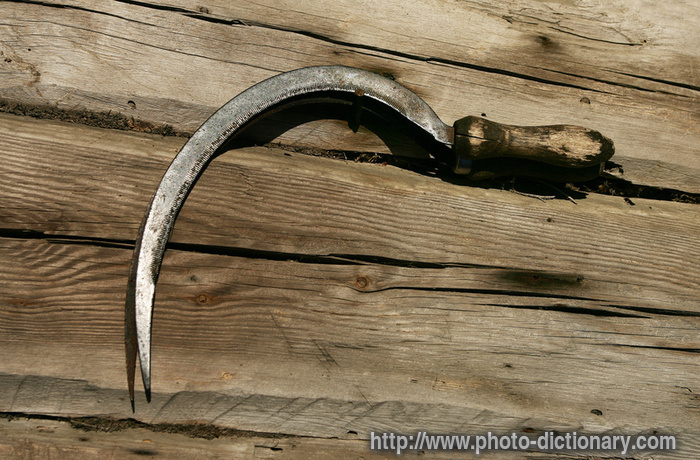
      • They often harvested their crops with their sickles (a sickle is a curved knife, like this).
      • More farmer lingo in this line: the "furrow" is a long, narrow, shallow hole that you drop seeds into. "Glebe" is an archaic word for farmland. Farmers would cut the furrow into the glebe using a plough, but if the ground is really hard to break into, you might describe it as "stubborn." Here's a pic of a plough cutting a furrow.
      • The speaker imagines that the farmers were cheerful, or jocund, as they drove their teams of oxen or mules into the field to plough.
      • The woods bowed to the stroke of their axes as they cleared forests to make their farms.
      • More personification! Even if you're really handy with an axe, the trees aren't going to bow down to you out of respect. They're just going to fall over.

        Lines 29-32

      • Let not Ambition mock their useful toil,
        Their homely joys, and destiny obscure;
        Nor Grandeur hear with a disdainful smile
        The short and simple annals of the poor.

        • More figurative language, y'all! The speaker personifies Ambition and Grandeur in these lines. You can tell because (a) he capitalizes them, as though they were proper nouns or names, and also because he says that they're doing stuff ("mocking" and "hearing") that only people do.
        • So, what's the deal with that personification? The speaker is telling the readers that they shouldn't mock the hard work, or the homely, simple pleasures, or the unsung, "obscure" destinies of the poor farmers in the graveyard. But he doesn't come out and tell the readers to lay off the mockery—instead, he says that they shouldn't allow "Ambition" to mock them. He's sort of displacing the blame. Regular people wouldn't mock these honest guys—only Ambition would be that cruel. Maybe he doesn't want the readers to feel as though he's shaking a finger at them, even though he kind of is.
        • Same deal with the second two lines of the stanza: the speaker says that we shouldn't allow "Grandeur," or high social status, to smile disdainfully or scornfully at the day-to-day accounts ("annals") of poor people.
        • Again, though, it seems like the speaker is personifying "Grandeur" to take the edge off of this stanza so that it won't sound like he's scolding the readers.
        • (Rule Number 1 of Writing: If you want to earn money from your writing, you probably shouldn't attack the audience or make them feel bad about themselves.)

          Lines 33-36

        • The boast of heraldry, the pomp of pow'r,
          And all that beauty, all that wealth e'er gave,
          Awaits alike th' inevitable hour.
          The paths of glory lead but to the grave.

          • Aha. Here's the real reason why the speaker doesn't want proud, ambitious, grand people to make fun of the poor people in the churchyard: it's because we're all heading there someday, too!
          • Here are a few nitty-gritty vocab notes before we start unraveling the sentence structure of these lines: "Heraldry" is the coat of arms associated with old, aristocratic families. Families with a coat of arms would embroider it on everything from their servants' coats to the outside of their carriage to the screen in front of the fireplace. Check out this example.
          • "Pomp" means proud, meaningless ceremony—basically, any ceremony designed to make people feel important but that doesn't really convey any meaning.
          • Last one: "inevitable" means unavoidable.
          • Phew. Okay. Now let's get back to the summary! The speaker starts with a list (this guy seems to be fond of lists). Here we go: 1) Bragging about your family's heraldry, 2) The empty ceremony of being in a position of power, and 3) The beauty that can be obtained from wealth—all of those things are waiting for the unavoidable, inevitable time. 
          • What time, you ask? Yep, you guessed it: all of those paths lead only to the GRAVE. 

            Lines 37-40

          • Nor you, ye proud, impute to these the fault,
            If Mem'ry o'er their tomb no trophies raise,
            Where thro' the long-drawn aisle and fretted vault
            The pealing anthem swells the note of praise.

            • The speaker has more advice to proud, rich, hoity-toity people: He addresses them as "ye proud," and tells them not to blame ("impute […] the fault") these dead poor dead people if they don't have fancy monuments ("trophies") over their graves.
            • More personification! Again, it's like the speaker is displacing blame. He says that "Memory" failed to put up fancy trophies or monuments, but really, wouldn't that be the responsibility of the families of the dead people? But of course, the dead guys in the churchyard are mostly poor farmers, so obviously their families wouldn't be able to afford a fancy marble monument in the church itself. So, the speaker shifts the blame onto the personified "Memory."
            • The last two lines of the stanza describe the church itself—the place where the monuments might be displayed. 
            • The bell that marks the passing of a member of the church "peals" in praise of his or her life all through the aisles of the church and up to its high, arched ("vaulted"), ornamentally carved ("fretted") ceiling.

              Lines 41-44

            • Can storied urn or animated bust
              Back to its mansion call the fleeting breath?
              Can Honour's voice provoke the silent dust,
              Or Flatt'ry soothe the dull cold ear of Death?

              • This stanza is a pair of rhetorical questions.
              • The speaker is still addressing the proud, hoity-toity readers—the ones that, he imagines, might have mocked the lowly farmers in the churchyard back in stanza 7.
              • He asks them whether a fancy-schmancy urn (a container to hold a dead person's remains) or a really life-like bust (a statue of a person's head and shoulders, in this case to commemorate a dead person) could call the breath back to a dead person and make him breathe again.
              • Except he doesn't say so quite that directly—he uses a metaphor. The dead person's body is a "mansion," and the speaker personifies the urn and the bust, asking if they can call the dead person's breath back to the mansion of their body. Phew, that's a mouthful!
              • Second rhetorical question: the speaker asks if the voice of "Honour" (another personification!) can provoke the silent, dusty remains of a dead person to speak again, or whether Flattery (another personification!) can make the cold ear of Death (yet another personification!) feel better about being dead.
              • (The answer to both of those rhetorical questions, obviously, is "No, of course not!")

                Lines 45-48

              • Perhaps in this neglected spot is laid
                Some heart once pregnant with celestial fire;
                Hands, that the rod of empire might have sway'd,
                Or wak'd to ecstasy the living lyre.

                • Now the speaker is reflecting on what type of person might be lying in the unmarked graves in the churchyard
                • Maybe, in the churchyard, there lies a person whose heart was once full ("pregnant" means full, here) of what the speaker calls "celestial fire."
                • Huh. What could that mean? Sounds like a metaphor to us, since no one's heart is literally full of fire, celestial or otherwise. "Celestial fire" must be a metaphor for passion.
                • Maybe, in the churchyard, there lies a person whose hands could have ruled an empire. Or someone whose hands could have played a lyre (a kind of old-school harp) so well that the lyre would have become conscious. That's playing a mean lyre!

                  Lines 49-52

                • But Knowledge to their eyes her ample page
                  Rich with the spoils of time did ne'er unroll;
                  Chill Penury repress'd their noble rage,
                  And froze the genial current of the soul.

                  • Yep, that's another personification in the first line—the capitalized noun probably tipped you off. 
                  • "Knowledge" is the subject of this sentence, but where's the verb? The sentence structure is wacky. Let's try to untangle it.
                  • Let's see…if we rearrange the sentence so that it's in a more usual structure, here's what it would look like: "Knowledge ne'er (never) did unroll her ample page, [which is] rich with the spoils of time, to their eyes."
                  • Okay, now that's starting to make more sense, but there's a metaphor there that needs more unraveling. Let's check it out.
                  • It's as though Knowledge is a big collection of pages, and, as time goes on, those pages get filled with more and more information—that's what the speaker calls the "spoils of time." ("Spoils" means "plunder" or "loot.")
                  • But these poor guys in the graveyard never had access to all the knowledge history had to offer—those pages were never "unrolled" "to their eyes."
                  • And why? Because poverty ("penury"= poverty) held back the noble parts of their characters—their passion, even their rage. 
                  • More personification! "Penury" is being treated like a person—it's the thing that repressed and froze the dead people's potential.
                  • And another metaphor, too: imagine that a person's soul is a river. Well, poverty can freeze up the current of your soul-river.
                  • This is a bummer, but the speaker might have a point. Let's read on…

                    Lines 53-56

                  • Full many a gem of purest ray serene,
                    The dark unfathom'd caves of ocean bear:
                    Full many a flow'r is born to blush unseen,
                    And waste its sweetness on the desert air.

                    • Wait, why are we talking about gems and flowers now? Must be more metaphor. Let's take a closer look:
                    • "Full many" is just an eighteenth-century phrase that means "lots of." So, lots of beautiful, pure gems are hidden away in dark caves under the ocean. 
                    • And lots of flowers come into blushing bloom without a human to see and appreciate their beauty or their sweet scent.
                    • This stanza is about unsung heroes, like the guys buried in the churchyard without monuments or "trophies," and both the gems and the flowers are metaphors for people who do awesome stuff that doesn't get recognized.
                    • Fun fact! These lines get quoted in Emma by Jane Austen, by the irritatingly self-important Mrs. Elton. Could be a sign that Austen, like Wordsworth, thought that Gray's poetry was too formal and stilted, since a character like Mrs. Elton is not exactly known for her good taste in literature. Of course, we love Thomas Gray, so this is one instance when we disagree with both Wordsworth and Austen!

                      lines 57-60

                    • Some village-Hampden, that with dauntless breast
                      The little tyrant of his fields withstood;
                      Some mute inglorious Milton here may rest,
                      Some Cromwell guiltless of his country's blood.

                      • The speaker muses that there might be dead people buried here that could have been famous revolutionaries or poets, but they died unknown and undiscovered.
                      • Maybe there was some village-version of John Hampden who stood up to tyranny on the village green! 
                      • (Historical side note: the real John Hampden was a Puritan politician who opposed the policies of King Charles I. He refused to pay a tax he thought was unfair. So Gray calls him "dauntless," or "fearless," for standing up to the "little tyrant," or the king.)
                      • Or maybe there was someone as brilliant as John Milton (you know, the guy who wrote Paradise Lost), but he died mute, without being able to express his brilliance. 
                      • Or maybe there was someone who would have wreaked as much havoc as Cromwell, but who didn't have a chance. 
                      • Another historical note! Oliver Cromwell was the leader of the anti-royalists during the English Civil War, helped bring about the execution of King Charles I, and became head of the short-lived English Commonwealth in 1649-1660. He wasn't a popular guy in the history books at the time Gray was writing.
                      • Another fun fact! Both Hampden and Milton were from the same area of England where Gray was writing his "Elegy." So maybe Gray liked to imagine that the same area could have produced other guys who were just as brilliant, but who remained unknown.

                        Lines 61-65

                      • Th' applause of list'ning senates to command,
                        The threats of pain and ruin to despise,
                        To scatter plenty o'er a smiling land,
                        And read their hist'ry in a nation's eyes,

                        Their lot forbade: […]
                        • We've been going through the poem one stanza at a time, but things get a bit too wacky here, and here's why: notice how Stanza 16 ends with a comma, and not a period? Yeah, we did, too. The sentence actually carries over between stanzas! This is called enjambment, and it can trip you up if you're not careful.
                        • Okay, so if we unravel the weird sentence structure, we can figure out what's going on here. You actually have to start at the end: The dead villagers in the graveyard are replaced with the pronoun "Their" in line 65. 
                        • The dead villagers' situation, or "lot," kept them from receiving ("commanding") the applause and approval of politicians.
                        • Their situation also made it impossible for them to blow off threats of pain and ruin. 
                        • Nor could they spread good stuff ("plenty") all over the country, even though that would win them a place in the history books in the eyes of their countrymen.
                        • Nope, the villagers were poor and died unknown because of their poverty, or "penury," as the speaker calls it in Stanza 13.

                          Lines 65-72

                        • …] nor circumscrib'd alone
                          Their growing virtues, but their crimes confin'd;
                          Forbade to wade through slaughter to a throne,
                          And shut the gates of mercy on mankind,

                          The struggling pangs of conscious truth to hide,
                          To quench the blushes of ingenuous shame,
                          Or heap the shrine of Luxury and Pride
                          With incense kindled at the Muse's flame.

                          • Again, we have to combine two stanzas because the sentence continues across the stanza break—more enjambment! 
                          • Not only does the poverty of the villagers prevent ("circumscribe" = prevent) them from developing the virtues that would get them remembered in the history books, it also keeps them from committing crimes.
                          • Here are some examples of the crimes these poor villagers just don't have time to commit, since they're busy working to put food on the table: 
                          • They don't have time to wade through blood and gore to kill a king on his throne, or to act all merciless to people.
                          • Another metaphor there! Slamming the "gates of mercy" is a metaphor for being merciless. (Try to work that one into everyday conversation. You can tell your athlete friends to "shut the gates of mercy" on the other team!)
                          • The villager's lot in life keeps them from trying to hide the truth, especially when the truth is struggling and conscious of BEING the truth.
                          • Their situation likewise keeps them from trying to hide their blushes. After all, a blush indicates that you're ashamed of something, right? So if you hide your blushes, you're hiding your true feelings. So this one goes along with the previous line.
                          • "Ingenuous" means innocent.
                          • And there's more metaphor here. You know how when you blush, your face feels hot? We talk about "quenching" flame, so here, the blush is the metaphorical flame that's getting "quenched."
                          • The poor villagers also don't have the chance to use fancy and flattering words to build a metaphorical shrine to the personified Luxury and Pride.
                          • The Muses were the goddesses in Greek and Roman mythology who were responsible for inspiring artists, musicians, and poets. So the "incense" that was lit at the Muse's flame must be a pen that is metaphorically kindled, lit up, or inspired by the Muses.

                            Lines 73-76

                          • Far from the madding crowd's ignoble strife,
                            Their sober wishes never learn'd to stray;
                            Along the cool sequester'd vale of life
                            They kept the noiseless tenor of their way.

                            • Since the poor villagers who are buried in the churchyard live far away from the noise and strife of crowded cities, they never learned to stray away from more sober, serious wishes and desires.
                            • Because they live in a secluded ("sequester'd") area, they were able to live their lives without making a lot of hubbub or noise.
                            • Fun fact! Thomas Hardy, the English novelist, gives a shout-out to Thomas Gray by titling one of his novels Far from the Madding Crowd.

                              Lines 77-80

                            • Yet ev'n these bones from insult to protect,
                              Some frail memorial still erected nigh,
                              With uncouth rhymes and shapeless sculpture deck'd,
                              Implores the passing tribute of a sigh.

                              • Even though these poor villagers don't have big fancy monuments or "trophies" over their graves, they at least still have frail, flimsy memorials nearby, if only to protect their remains from the insult of having people picnic or play cricket on their graves.
                              • These flimsy memorials aren't made out of fancy marble—they just have rough, shapeless sculptures to ornament ("deck") them, and are decorated with crude, uncouth poetry.
                              • But even though the memorials aren't all fancy, they still inspire passersby to pause long enough to sigh. So there!

                                Lines 81-84

                              • Their name, their years, spelt by th' unletter'd muse,
                                The place of fame and elegy supply:
                                And many a holy text around she strews,
                                That teach the rustic moralist to die. 

                                • The "frail" monuments (78) are engraved only with the dead people's name and the years of their birth and death, and even this simple inscription was clearly made by someone who was largely illiterate, or "unlettered."
                                • The speaker uses irony when he says that inscription was made by a "muse." Since the muses were goddesses of poetry, how could they be unlettered or illiterate?
                                • These simple inscriptions take the place of fame and fancy elegies (poems written in memory of dead people).
                                • "She" is the muse referred to in the previous line.
                                • The "unlettered muse" also adds ("strews") the occasional Bible verse ("holy text") that inspires country folks to think about death so that they'll be prepared when their time comes.

                                  Lines 85-88

                                • For who to dumb Forgetfulness a prey,
                                  This pleasing anxious being e'er resign'd,
                                  Left the warm precincts of the cheerful day,
                                  Nor cast one longing, ling'ring look behind?

                                  • After all, the speaker asks, who is going to give up ("resign") their life ("being"), which is both pleasing and anxious, or to leave the warm environment of the earth, without looking behind them at what they leave behind—especially someone who, like the villagers, is going to be forgotten when he or she is dead?
                        1. We get another metaphor here in line 85, and some more personification, too! Being forgotten when you're dead is like being hunted down as the "prey" of a predator called "Forgetfulness." Sounds scary!
                                  • Finally, we get more alliteration here, with the repeated beginning L sound in "longing, ling'ring look."

                                    Lines 89-92


                                  • On some fond breast the parting soul relies,
                                    Some pious drops the closing eye requires;
                                    Ev'n from the tomb the voice of Nature cries,
                                    Ev'n in our ashes live their wonted fires.

                                    • Even simple, poor, country folks like the villagers in the churchyard depend on their loved ones as they die (or as their souls "part" from the world).
                                    • They need some pious, religious friend or neighbor to close their eyes for them as they die.
                                    • It's only natural, after all—it's the "voice of Nature" (yep, "Nature" is—you guessed it—being personified!).
                                    • That voice of Nature calls out from the grave, and the villagers' accustomed passions (their "wonted fires") live on in their ashes, or their remains.

summary of elegy

Summary


The speaker is hanging out in a churchyard just after the sun goes down. It's dark and a bit spooky. He looks at the dimly lit gravestones, but none of the grave markers are all that impressive—most of the people buried here are poor folks from the village, so their tombstones are just simple, roughly carved stones.
The speaker starts to imagine the kinds of lives these dead guys probably led. Then he shakes his finger at the reader, and tells us not to get all snobby about the rough monuments these dead guys have on their tombs, since, really, it doesn't matter what kind of a tomb you have when you're dead, anyway. And guys, the speaker reminds us, we're all going to die someday.
But that gets the speaker thinking about his own inevitable death, and he gets a little freaked out. He imagines that someday in the future, some random guy (a "kindred spirit") might pass through this same graveyard, just as he was doing today. And that guy might see the speaker's tombstone, and ask a local villager about it. And then he imagines what the villager might say about him.
At the end, he imagines that the villager points out the epitaph engraved on the tombstone, and invites the passerby to read it for himself. So basically, Thomas Gray writes his own epitaph at the end of this poem.

shafqat ullah khan
imsportful@gmail.com

elegy by thomas gray (text)

Elegy Written in a Country Churchyard

By Thomas Gray
The curfew tolls the knell of parting day,
         The lowing herd wind slowly o'er the lea,
The plowman homeward plods his weary way,
         And leaves the world to darkness and to me.

Now fades the glimm'ring landscape on the sight,
         And all the air a solemn stillness holds,
Save where the beetle wheels his droning flight,
         And drowsy tinklings lull the distant folds;

Save that from yonder ivy-mantled tow'r
         The moping owl does to the moon complain
Of such, as wand'ring near her secret bow'r,
         Molest her ancient solitary reign.

Beneath those rugged elms, that yew-tree's shade,
         Where heaves the turf in many a mould'ring heap,
Each in his narrow cell for ever laid,
         The rude forefathers of the hamlet sleep.

The breezy call of incense-breathing Morn,
         The swallow twitt'ring from the straw-built shed,
The cock's shrill clarion, or the echoing horn,
         No more shall rouse them from their lowly bed.

For them no more the blazing hearth shall burn,
         Or busy housewife ply her evening care:
No children run to lisp their sire's return,
         Or climb his knees the envied kiss to share.

Oft did the harvest to their sickle yield,
         Their furrow oft the stubborn glebe has broke;
How jocund did they drive their team afield!
         How bow'd the woods beneath their sturdy stroke!

Let not Ambition mock their useful toil,
         Their homely joys, and destiny obscure;
Nor Grandeur hear with a disdainful smile
         The short and simple annals of the poor.

The boast of heraldry, the pomp of pow'r,
         And all that beauty, all that wealth e'er gave,
Awaits alike th' inevitable hour.
         The paths of glory lead but to the grave.

Nor you, ye proud, impute to these the fault,
         If Mem'ry o'er their tomb no trophies raise,
Where thro' the long-drawn aisle and fretted vault
         The pealing anthem swells the note of praise.

Can storied urn or animated bust
         Back to its mansion call the fleeting breath?
Can Honour's voice provoke the silent dust,
         Or Flatt'ry soothe the dull cold ear of Death?

Perhaps in this neglected spot is laid
         Some heart once pregnant with celestial fire;
Hands, that the rod of empire might have sway'd,
         Or wak'd to ecstasy the living lyre.

But Knowledge to their eyes her ample page
         Rich with the spoils of time did ne'er unroll;
Chill Penury repress'd their noble rage,
         And froze the genial current of the soul.

Full many a gem of purest ray serene,
         The dark unfathom'd caves of ocean bear:
Full many a flow'r is born to blush unseen,
         And waste its sweetness on the desert air.

Some village-Hampden, that with dauntless breast
         The little tyrant of his fields withstood;
Some mute inglorious Milton here may rest,
         Some Cromwell guiltless of his country's blood.

Th' applause of list'ning senates to command,
         The threats of pain and ruin to despise,
To scatter plenty o'er a smiling land,
         And read their hist'ry in a nation's eyes,

Their lot forbade: nor circumscrib'd alone
         Their growing virtues, but their crimes confin'd;
Forbade to wade through slaughter to a throne,
         And shut the gates of mercy on mankind,

The struggling pangs of conscious truth to hide,
         To quench the blushes of ingenuous shame,
Or heap the shrine of Luxury and Pride
         With incense kindled at the Muse's flame.

Far from the madding crowd's ignoble strife,
         Their sober wishes never learn'd to stray;
Along the cool sequester'd vale of life
         They kept the noiseless tenor of their way.

Yet ev'n these bones from insult to protect,
         Some frail memorial still erected nigh,
With uncouth rhymes and shapeless sculpture deck'd,
         Implores the passing tribute of a sigh.

Their name, their years, spelt by th' unletter'd muse,
         The place of fame and elegy supply:
And many a holy text around she strews,
         That teach the rustic moralist to die.

For who to dumb Forgetfulness a prey,
         This pleasing anxious being e'er resign'd,
Left the warm precincts of the cheerful day,
         Nor cast one longing, ling'ring look behind?

On some fond breast the parting soul relies,
         Some pious drops the closing eye requires;
Ev'n from the tomb the voice of Nature cries,
         Ev'n in our ashes live their wonted fires.

For thee, who mindful of th' unhonour'd Dead
         Dost in these lines their artless tale relate;
If chance, by lonely contemplation led,
         Some kindred spirit shall inquire thy fate,

Haply some hoary-headed swain may say,
         "Oft have we seen him at the peep of dawn
Brushing with hasty steps the dews away
         To meet the sun upon the upland lawn.

"There at the foot of yonder nodding beech
         That wreathes its old fantastic roots so high,
His listless length at noontide would he stretch,
         And pore upon the brook that babbles by.

"Hard by yon wood, now smiling as in scorn,
         Mutt'ring his wayward fancies he would rove,
Now drooping, woeful wan, like one forlorn,
         Or craz'd with care, or cross'd in hopeless love.

"One morn I miss'd him on the custom'd hill,
         Along the heath and near his fav'rite tree;
Another came; nor yet beside the rill,
         Nor up the lawn, nor at the wood was he;

"The next with dirges due in sad array
         Slow thro' the church-way path we saw him borne.
Approach and read (for thou canst read) the lay,
         Grav'd on the stone beneath yon aged thorn."

THE EPITAPH
Here rests his head upon the lap of Earth
       A youth to Fortune and to Fame unknown.
Fair Science frown'd not on his humble birth,
       And Melancholy mark'd him for her own.

Large was his bounty, and his soul sincere,
       Heav'n did a recompense as largely send:
He gave to Mis'ry all he had, a tear,
       He gain'd from Heav'n ('twas all he wish'd) a friend.

No farther seek his merits to disclose,
       Or draw his frailties from their dread abode,
(There they alike in trembling hope repose)
       The bosom of his Father and his God. 

Wednesday, 1 January 2014

norman conquest

After the battle

After the battle of Hastings was won, William of Normandy expected the English lords to pay tribute to him. However, this did not happen. So he decided to rest his army for some time before proceeding to London.

The Battle of Hastings

The Battle of Hastings which took place on October 14, 1066 is considered to the decisive battle resulting in the Norman conquest of England. The battle took place at Senlac Hill, about ten kms from Hastings.
The Norman strategy for the battle relied on the archers attacking the enemy with arrows, the infantry which would engage the enemy in combat and a final charge by the cavalry. However, the English army formed a shield wall to protect themselves, so the arrows had little effect on them. The Norman infantry then charged up the hill, but were faced by a barrage of stones, javelins and other weapons. The cavalry charge also was ineffective, as the horses shied away from the axes, swords and other weapons.
After an hour of battle, the Norman army suffered heavy casualties. Seeing this, the undisciplined English army were tempted to pursue the enemy. They broke their formations and dispersed. As they were no longer protected by the shield wall, the Norman invaders led by William, could easily attack and kill the Englishmen. By the time, the English army realised that it was counter-attacked, it was too late.
The archers in the Norman army launched an attack over the shield wall, targetting the fighters at the rear of the army. One of the arrows hit King Harold in the eye and he was killed. With their leader and many nobles killed, the fyrd or part time soldiers scattered and many fled the battlefield, resulting in a victory for the Norman army.

The Norman and English armies

The army of Duke William of Normandy  had a large number of trained warriors or mercernaries who fought with him for a share of the spoils of war.
It had a strength of 8,400 soldiers consisting of 2,200 cavalry, 1,700 archers and 4,500 infantry (men-at-arms). The archers would first attack the enemy, and would be followed by the infantry and a cavalry charge.
The strength of the English army was 7,500 and consisted entirely of infantry. Of these , about 2,000 were Housecarls, full time professional soldiers who were dedicated to the King of England and would fight to the last man. The rest of the army were 5,500 fyrd, who were part time soldiers drawn from small landholding nobility.

The Norman invasion

Normandy was a region in the  northern part of France, just across the English channel. In 911, the Viking, Rollo settled in this region after an agreement with the king of France. He was expected to protect the region from further Viking attacks.Normandy was a feudal state, where the vassals held land in return for military service.
In 1066, the Duchy of Normandy was ruled by Duke William who also though he had a right to the throne of England . He had been assembling an army to invade England, which also included contingents from other parts of France like Britanny and Flanders.
Soon after  the battle of Stamford Bridge got over, Duke William and his army crossed the English channel and landed in England on September 28, 1066 A.D.
On hearing the news of the Norman army landing on the English coast, Harold Godwinson marched south with his army to battle the Norman invaders. He halted briefly at London, to gather more people. This was a strategic mistake as his army was tired and could not match the Norman invaders at the battle of Hastings.

Battle of Stamford Bridge

King Harald of Norway (commonly known as Harald Hardrada) was one of the many claimants to the throne of England.  He believed he had a right to the throne of England based on a treaty between the King of Norway and one of earlier Kings of England.
In early September 1066, Harald invaded northern England with a fleet of 300 ships and about 15000 men. He was assisted by the estranged and exiled brother of Harold Godwinson, Tostig Godwinson. Initially the Norwegian invaders were successful and were able to capture the city of York.
The army of Harold Godwinson was rushed to the north of the country to battle the invaders. A fierce battle took place at Stamford Bridge on 16th September 1066, and the Norwegian invaders suffered a crushing defeat. King Harald of Norway was killed in the battle.  Out of the 300 ships that had reached England, only 24 could return with the injured warriors.
Though the English army was victorious in the battle of Stamford Bridge, it also suffered losses. It was in a battered and weakened state which adversely affected its capacity to repel the Norman  invasion of England.

Background

The Norman conquest of England took place in 1066. At the beginner of 1066, the Anglo Saxon ruler of England, Edward the Confessor was on his deathbed.  Since he had no children, there was no direct heir to the throne and he had not publicly designated any heir to succeed him.
After Edward the Confessor died on January 5th,1066, he was succeeded by Harold Godwinson, whose sister was married to Edward the Confessor. He claimed that Edward the Confessor had annoited him the successor on his deathbed in the presence of the queen. Since Harold Godwinson was a powerful lord in the country, he soon received the approval of the Witan, the decision making body who could decide who would be king.
This was resented by William of Normandy (a region in Northern France today). He was distantly related to Edward the Confessor and claimed that Edward the Confessor had promised him the throne  of England on his death.

Tuesday, 31 December 2013

battle of hasting norman conquest

Invasion of England, 1066

The Battle of Hastings
King Edward of England (called "The Confessor" because of his construction of Westminster Abbey) died on January 5, 1066, after a reign of 23 years. Leaving no heirs, Edward's passing ignited a three-way rivalry for the crown that culminated in the Battle of Hastings and the destruction of the Anglo-Saxon rule of England.
Harold Godwinson
From the Bayeux Tapestey
 
The leading pretender was Harold Godwinson, the second most powerful man in England and an advisor to Edward. Harold and Edward became brothers-in-law when the king married Harold's sister. Harold's powerful position, his relationship to Edward and his esteem among his peers made him a logical successor to the throne. His claim was strengthened when the dying Edward supposedly uttered "Into Harold's hands I commit my Kingdom." With this kingly endorsement, the Witan (the council of royal advisors) unanimously selected Harold as King. His coronation took place the same day as Edward's burial. With the placing of the crown on his head, Harold's troubles began.
Across the English Channel, William, Duke of Normandy, also laid claim to the English throne. William justified his claim through his blood relationship with Edward (they were distant cousins) and by stating that some years earlier, Edward had designated him as his successor. To compound the issue, William asserted that the message in which Edward anointed him as the next King of England had been carried to him in 1064 by none other than Harold himself. In addition, (according to William) Harold had sworn on the relics of a martyred saint that he would support William's right to the throne. From William's perspective, when Harold donned the Crown he not only defied the wishes of Edward but had violated a sacred oath. He immediately prepared to invade England and destroy the upstart Harold. Harold's violation of his sacred oath enabled William to secure the support of the Pope who promptly excommunicated Harold, consigning him and his supporters to an eternity in Hell.
The third rival for the throne was Harald Hardrada, King of Norway. His justification was even more tenuous than William's. Hardrada ruled Norway jointly with his nephew Mangus until 1047 when Mangus conveniently died. Earlier (1042), Mangus had cut a deal with Harthacut the Danish ruler of England. Since neither ruler had a male heir, both promised their kingdom to the other in the event of his death. Harthacut died but Mangus was unable to follow up on his claim to the English throne because he was too busy battling for the rule of Denmark. Edward became the Anglo-Saxon ruler of England. Now with Mangus and Edward dead, Hardrada asserted that he, as Mangus's heir, was the rightful ruler of England. When he heard of Harold's coronation, Hardrada immediately prepared to invade England and crush the upstart.
The Invasions of England, 1066
 
Hardrada of Norway struck first. In mid September, Hardrada's invasion force landed on the Northern English coast, sacked a few coastal villages and headed towards the city of York. Hardrada was joined in his effort by Tostig, King Harold's nere-do-well brother. The Viking army overwhelmed an English force blocking the York road and captured the city. In London, news of the invasion sent King Harold hurriedly north at the head of his army picking up reinforcements along the way. The speed of Harold's forced march allowed him to surprise Hardrada's army on September 25, as it camped at Stamford Bridge outside York. A fierce battle followed. Hand to hand combat ebbed and flowed across the bridge. Finally the Norsemen's line broke and the real slaughter began. Hardrada fell and then the King's brother, Tostig. What remained of the Viking army fled to their ships. So devastating was the Viking defeat that only 24 of the invasion force's original 240 ships made the trip back home. Resting after his victory, Harold received word of William's landing near Hastings.
Construction of the Norman invasion fleet had been completed in July and all was ready for the Channel crossing. Unfortunately, William's ships could not penetrate an uncooperative north wind and for six weeks he languished on the Norman shore. Finally, on September 27, after parading the relics of St. Valery at the water's edge, the winds shifted to the south and the fleet set sail. The Normans made landfall on the English coast near Pevensey and marched to Hastings.
Harold rushed his army south and planted his battle standards atop a knoll some five miles from Hastings. During the early morning of the next day, October 14, Harold's army watched as a long column of Norman warriors marched to the base of the hill and formed a battle line. Separated by a few hundred yards, the lines of the two armies traded taunts and insults. At a signal, the Norman archers took their position at the front of the line. The English at the top of the hill responded by raising their shields above their heads forming a shield-wall to protect them from the rain of arrows. The battle was joined.
The English fought defensively while the Normans infantry and cavalry repeatedly charged their shield-wall. As the combat slogged on for the better part of the day, the battle's outcome was in question. Finally, as evening approached, the English line gave way and the Normans rushed their enemy with a vengeance. King Harold fell as did the majority of the Saxon aristocracy. William's victory was complete. On Christmas day 1066, William was crowned King of England in Westminster Abbey.
The Bayeux Tapestry
The Bayeux Tapestry (actually an embroidery measuring over 230 feet long and 20 inches wide) describes the Norman invasion of England and the events that led up to it. It is believed that the Tapestry was commissioned by Bishop Odo, bishop of Bayeux and the half-brother of William the Conqueror. The Tapestry contains hundreds of images divided into scenes each describing a particular event. The scenes are joined into a linear sequence allowing the viewer to "read" the entire story starting with the first scene and progressing to the last. The Tapestry would probably have been displayed in a church for public view.
History is written by the victors and the Tapestry is above all a Norman document. In a time when the vast majority of the population was illiterate, the Tapestry's images were designed to tell the story of the conquest of England from the Norman perspective. It focuses on the story of William, making no mention of Hardrada of Norway nor of Harold's victory at Stamford Bridge. The following are some excerpts taken from this extraordinary document.
King Edward sends Harold on a Mission
King Edward sends Harold
on a mission
 
The Tapestry's story begins in 1064. King Edward, who has no heirs, has decided that William of Normandy will succeed him. Having made his decision; Edward calls upon Harold to deliver the message.
This at any rate, is the Norman interpretation of events for King Edward's selection of William is critical to the legitimacy of William's later claim to the English crown. It is also important that Harold deliver the message, as the tapestry explains in later scenes.
In this scene King Edward leans forward entrusting Harold with his message. Harold immediately sets out on his fateful journey.
Harold Swears an Oath to William
Pursuing his mission, the Tapestry describes how Harold crosses the English Channel to Normandy, is held hostage by a Norman count and is finally rescued by William.
Harold swears an oath
 
Harold ends up in William's castle at Bayeux on the Norman coast where he supposedly delivers the message from King Edward. At this point the Tapestry describes a critical event. Having received the message that Edward has anointed him as his successor; William calls upon Harold to swear an oath of allegiance to him and to his right to the throne. The Tapestry shows Harold, both hands placed upon religious relics enclosed in two shrines, swearing his oath as William looks on. The onlookers, including William, point to the event to add further emphasis. One observer (far right) places his hand over his heart to underscore the sacredness of Harold's action. Although William is seated, he appears larger in size than Harold. The disproportion emphasizes Harold's inferior status to William. The Latin inscription reads "Where Harold took an oath to Duke William."


- continued -
The Death and Burial of Edward the Confessor
The Tapestry describes Harold's return to England after swearing his oath to William and his report to King Edward. The story then advances forward two years to 1066 and the death of Edward.
Death and Burial of Edward
The death and burial of King Edward is presented in three scenes whose chronological order is reversed. The first image (1) depicts Westminster Abbey. This is followed by Edward's funeral procession (2) and then his death (3).
The Death of Edward
The Death of King Edward
 
In this scene (3) Edward is presented as both alive and dead. In the top portion of the panel Edward converses with those gathered at his bedside. The Latin inscription reads "Here King Edward addresses his faithful ones." At the foot of his bed sits Edward's wife who is also Harold's sister. At the side of the bed stands Stigand, the archbishop of Canterbury who performs a religious ceremony. The dying king addresses Harold who kneels in front of him. It is here that Edward supposedly anointed Harold as his successor giving legitimacy to Harold's claim to the crown.
In the lower panel Edward is prepared for burial. The bishop performs last rites while the embalmers go about their work. The Latin inscription reads "And here he died."
The Procession
King Edward's Funeral Procession
 
Edwards' body, wrapped in linen, is carried to the church for burial (2). The Latin inscription reads "Here the body of King Edward is carried to the Church of St. Peter the Apostle." Edward's burial took place on January 6, 1066.
In its entry for the year 1066, the Anglo-Saxon Chronicle describes Edward's death as follows: "In this year was consecrated the minster at Westminster, on Childer-mass-day. And King Edward died on the eve of Twelfth-day; and he was buried on Twelfth-day within the newly consecrated church at Westminster. And Harold the earl succeeded to the kingdom of England, even as the king had granted it to him, and men also had chosen him thereto; and he was crowned as king on Twelfth-day."
Westminster Abbey
Westminster Abbey
 
Edward's funeral procession completes its journey at Westminster Abbey (1). King Edward began work on the abbey in 1050 and construction was completed shortly before his death. The pious Edward was awarded the distinction "the Confessor" for his effort. Unfortunately, the King fell ill on Christmas eve and was unable to attend the abbey's consecration.
The Tapestry conveys the newness of the abbey by the workman affixing the weather vane atop the roof to the left. God's blessing upon the consecrated structure is represented by the hand appearing from the clouds above.
A Bad Omen: the Appearance of Halley's Comet
Halley's Comet (upper left)
 
Harold is crowned king on January 6. In the spring, near Easter, a comet appears in the sky. The Anglo-Saxon Chronicle describes the event: "Easter was then on the sixteenth day before the calends of May. Then was over all England such a token seen as no man ever saw before. Some men said that it was the comet-star, which others denominate the long-hair'd star. It appeared first on the eve called 'Litania major', that is, on the eighth before the calends of May; and so shone all the week."
We now know that the comet-star in the sky was Halley's Comet making one of its 76-year cyclical appearances. In the Tapestry, an attendant rushes to tell Harold of the celestial happening as he sits upon his throne. The comet appears at the upper left. The portrayal acquires a sense of foreboding as empty long boats appear below the scene. These no doubt presage the invasion fleet William will employ to cross the Channel. The Tapestry implies that the appearance of the comet expresses God's wrath at Harold for breaking his oath to William and assuming the throne. Retribution will be found in the invasion fleet.
William Launches His Invasion
Upon hearing the news of Harold's coronation, William immediately orders the building of an invasion fleet. The Tapestry describes in detail the construction of the fleet and preparations for the invasion providing insight into eleventh century building techniques. With preparations complete, William waits on the Normandy shore for a favorable wind to take him to England.
William's Flagship
 
The favorable wind arrives on September 27, and the fleet sets sail, its ships loaded with knights, archers, infantry, horses and the lumber necessary to build two or three forts. This scene shows William's ship as the fleet approaches Pevensy on the English shore. A cross adorns the top of the ship's mast. Below the cross, a lantern guides the way for the rest of the fleet. Shields line the ship's gunwales, reminiscent of the practice of the Norman's Viking ancestors. A dragon's head sits on the ship's prow and a bugler blows his horn at the ship's stern. A ship laden with horses sails along side William's craft. The fleet lands on September 28 and the invasion army makes its way to Hastings.
The Battle
 
The Battle
This is one of many scenes depicting the ferocity of the battle. Wielding his battle-axe, a Saxon deals a death-blow to the horse of a Norman. This was the first time the Normans had encountered an enemy armed with the battle-axe. For the Saxons, this was the first time they had battled an enemy mounted on horseback. This scene probably describes the later stages of the battle when the Norman knights had broken through the Saxon shield wall. At the bottom of the scene lay the dead bodies of both Normans and Saxons. 
The Death of Harold
The Death of Harold
 
King Harold tries to pull an arrow from his right eye. Several arrows are lodged in his shield showing he was in the thick of the battle. To the right, a Norman knight cuts down the wounded king assuring his death. At the bottom of the scene the victorious Normans claim the spoils of war as they strip the chain mail from bodies while collecting shields and swords from the dead. Scholars debate the meaning of this scene, some saying that the man slain by the knight is not Harold, others contesting that the man with the arrow wound is not Harold, others claiming that both represent Harold. The Latin inscription reads "Here King Harold was killed." The Tapestry ends its story after the death of Harold.
William ruled England until his death in 1087. The Anglo-Saxon Chronicle recalls the Norman King in its entry for that year: "But amongst other things is not to be forgotten that good peace that he made in this land; so that a man of any account might go over his kingdom unhurt with his bosom full of gold. No man durst slay another, had he never so much evil done to the other; and if any churl lay with a woman against her will, he soon lost the limb that he played with. He truly reigned over England; and by his capacity so thoroughly surveyed it, that there was not a hide of land in England that he wist not who had it, or what it was worth, and afterwards set it down in his book."
References:
   Bernstein, David, The Mystery of the Bayeux Tapestry (1987); Howarth, David, 1066 the Year of the Conquest (1978); Ingram, James (translator), The Anglo-Saxon Chronicle (1823); Wood, Michael, In Search of the Dark Ages (1987).